Position sensors for hydraulic cylinders
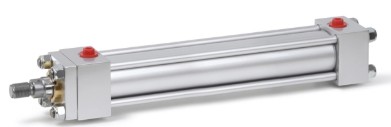
A hydraulic cylinder can report the piston position — from end-of-stroke positions to continuous measurement over the whole stroke. The key difference: inductive proximity switches sense only the end-of-stroke positions of the rod and sit in the cylinder end caps; the magnetic switches SR / SH can be placed anywhere on the tie-rods of the MD series, so they report both end and intermediate positions; on compact MP cylinders the sensor slides in grooves along the cylinder body; and servo cylinders measure the position continuously over the whole stroke. This is also the direction of Conforti's "smart" cylinders — they integrate position sensing and data transfer to the control system (Industry 4.0 logic). This article shows which sensor for which cylinder and for which application is the right fit. Supplied by hydraulika.store, authorised distributor of Conforti Oleodinamica for the Czech Republic, Slovakia and the EU.
- MD / MP — directly on the series page in the configurator: after selecting the MD or MP series, a Sensor settings section appears at the bottom where you choose the type (SR or SH for MD, SP for MP) and the number of sensors.
- Proximity (SPV / SPZ / SPK) — after adding the cylinder to your inquiry a pop-up appears; after the accessories step comes the "Step 2/3: Optional features" step, where you select the inductive switches.
- Servo cylinders (transducer) — on the servo cylinders page the Sensor output (transducer) can be chosen directly in the configurator.
On the 3D model of the servo cylinder the transducer (position sensor) is not shown in the configurator — you can identify it in the code, e.g. TD MV…
Then simply submit your inquiry and we will prepare a quote tailored to your requirements.
Article contents
Which sensor for which cylinder and application
| Sensor | Cylinder series | What it detects | When to choose (application) |
|---|---|---|---|
| SR / SH (magnetic switch) | MD (tie-rod CD / DK) | piston passing chosen points — intermediate and end positions | sequential control, simple feedback to a PLC, several positions along the stroke |
| SP (magnetic sensor) | MP (compact) | piston position on a compact cylinder | clamping, small automation units, minimal installation space |
| SPV / SPZ / SPK (proximity) | CD / DK / MD, HD / HK, DP (with cushioning) | end-of-stroke positions (tied to cushioning) | smooth and controlled handling, fixed end points tied to cushioning |
| Magnetostrictive transducer | servo TD / TK / TH / TX / TP | absolute position continuously over the whole stroke | servo control, precise and repeatable positioning, position/force regulation |
What can be fitted to each series
| Cylinder series | Possible position sensing | When to use / application |
|---|---|---|
| CD / DK (tie-rod) | end-of-stroke proximity (SPV/SPZ/SPK) or servo version (+ the MD variant) | standard industrial movements where you want to monitor the end points; for positions along the stroke use the MD variant |
| MD | SR / SH switches (intermediate and end positions) | sequential control, several positions along the stroke, feedback to a PLC |
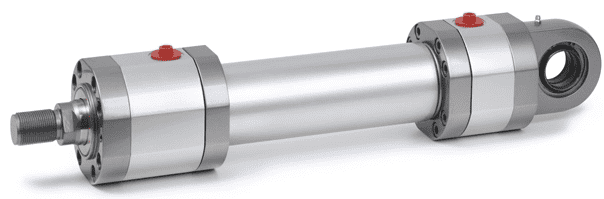
| HD / HK (flange-mounted) | end-of-stroke proximity only (SPV/SPZ/SPK) or the servo version | long strokes and end-of-stroke monitoring; precise travel only as a servo cylinder |
| DP (ISO 6022, heavy-duty) | end-of-stroke proximity only or the servo version (TP) | high loads and end-of-stroke positions; precise positioning as the TP servo cylinder |
| Compact RP / MP / RQ | only MP with the SP sensor; RP and RQ cannot sense position | clamping, small automation units, minimal installation space |
| Servo TD / TK / TH / TX / TP | integrated magnetostrictive sensor (absolute, continuous) | servo control, precise and repeatable positioning, position/force regulation, axis synchronisation |
General guidance: if you only need to know that the piston has reached its end, switches or proximity sensors (end-of-stroke) are enough. If you need to monitor several positions along the stroke, choose a tie-rod MD cylinder with SR / SH switches. If you need to know exactly where the piston is at every moment, choose a servo cylinder with a magnetostrictive sensor. For flange-mounted HD / HK and heavy-duty DP cylinders there are in practice only two routes — proximity for end-of-stroke positions, or straight to the servo version. How to choose the cylinder itself is described in the article How to choose a double-acting hydraulic cylinder.
Three sensing principles
The sensing method differs according to what the cylinder is to report and how it is built. Conforti offers three principles:
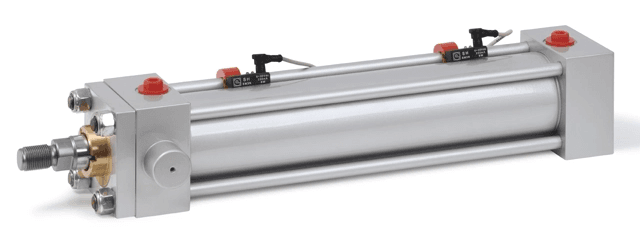
- Magnetic sensors — require a magnetic piston and a stainless-steel tube. On the tie-rods of the MD series (the CD / DK ISO 6020/2 variant) the SR / SH switches are used, which can be placed anywhere along the tie-rod, so they report both end and intermediate positions. On compact MP cylinders the SP sensor slides in grooves along the cylinder body and can be set anywhere along the stroke; the RP and RQ series do not have a magnetic piston, so no sensor is fitted to them.
- Inductive proximity (SPV / SPZ / SPK) — sense only the end-of-stroke positions of the rod; they are integrated into the cylinder end caps and are tied to the cushioning. They do not need a magnetic piston — compatible across the whole range: ISO 6020/2 tie-rod (CD / DK) and flange-mounted (HD / HK) and ISO 6022 (DP).
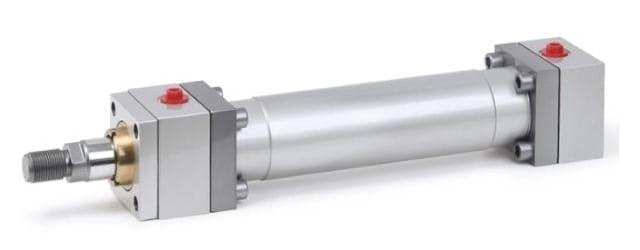
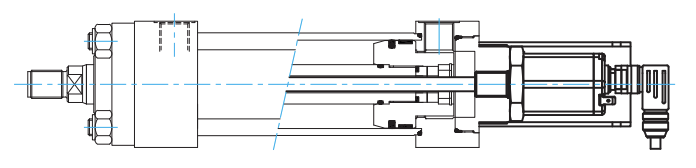
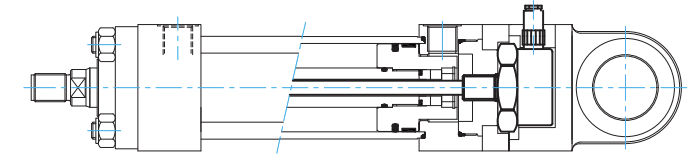
- Integrated magnetostrictive sensor (transducer) — the dedicated servo series TD / TK / TH / TX / TP; measures the position continuously over the whole stroke. The sensor is mounted mostly externally on the rear flange of the cylinder; with some mountings (e.g. rod eye) it can be internal — with a 90° output built into the cylinder body — such a solution must be discussed with the technical department.
So a simple rule applies: intermediate positions and points along the stroke can only be sensed by the sliding switches on the tie-rods (MD), or the compact MP. End-of-stroke positions can be monitored by proximity switches (with cushioning) on almost every series. A precise continuous position is provided only by a servo cylinder. The series and their options are summarised in the tables above.
MD — SR / SH switches
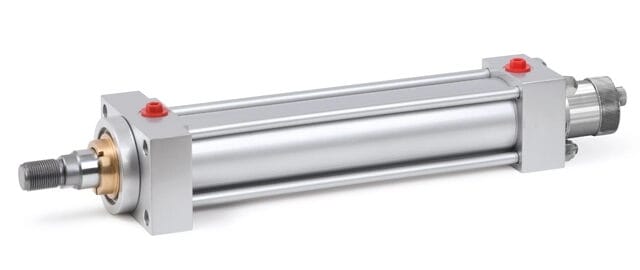
The MD series is a variant of the tie-rod CD / DK cylinders with an added magnetic piston and a stainless-steel tube. One or more switches are fastened to the tie-rods and slid along the stroke to the points where the piston passing is to be reported — intermediate and end positions. When to use: sequential control and simple feedback to a PLC where you need to monitor several positions along the stroke (feeds, stackers, clamping).
| Switch | Type | Voltage | Protection |
|---|---|---|---|
| SR | REED contact | 3–110 V AC/DC | IP67 |
| SH | PNP (magnetoresistive) | 6–30 V DC | IP67 |
The switches are fastened with mounting clamps according to the bore: STA (Ø 25–40), STB (Ø 50–63), STC (Ø 80–100) and STD (Ø 125). Beware of sources of interference: strong magnetic fields (electric motors, coils, inverters) or ferromagnetic masses near the cylinder can affect the sensing; with long cables (over 3 m) and heavy vibration, verify the wiring. Series details on the landing page cylinders with end-of-stroke sensing (MD).


MP — SP sensor
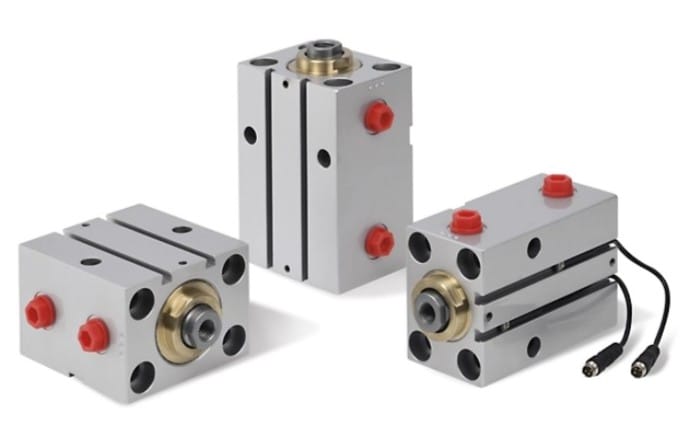
Of the compact cylinders, only the MP series can sense position — it has a magnetic piston. Conventional REED or magnetoresistive sensors (SP) can be placed in the grooves anywhere along the stroke to detect the piston passing. The compact RP and RQ series do not have a magnetic piston, so no sensor is fitted to them.
New electronic IO-LINK sensors read the piston of a compact cylinder over the whole stroke — they provide either continuous position read-out or an ON/OFF signal at up to 8 programmable switching points. They are compatible with the entire range of short-stroke MP cylinders and fitting requires no design changes — an existing cylinder can therefore be upgraded (retrofit) into a digitally monitorable element without replacing the whole unit.
When to use: where there is little space yet feedback is still needed — clamping, small automation units, fixtures. Overview on the landing page compact hydraulic cylinders RP / MP / RQ.
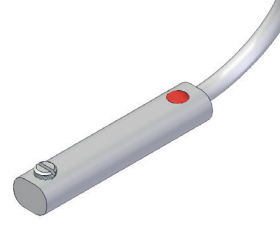
Proximity SPV / SPZ / SPK
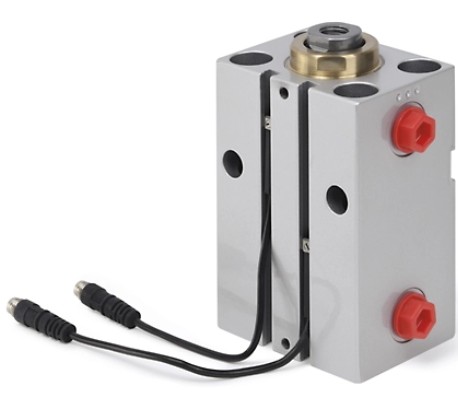
Inductive end-of-stroke proximity switches are fitted into a free position on the cylinder head (typically position 4) and are tied to the cushioning direction. They do not need a magnetic piston, so they can also be fitted to CD / DK, HD / HK and DP — anywhere there is cushioning in the relevant direction:
- SPV — front switch (front end position, front cushioning).
- SPZ — rear switch (rear end position, rear cushioning).
- SPK — switch at both front and rear; requires cushioning in both positions (K).
When to use: end-of-stroke detection where smooth and controlled handling is desired and it also makes sense to tie the sensing to the end cushioning — lifting and handling, presses, long strokes. Unlike the sliding MD switches, these are fixed, defined end points. The positions of the oil ports and cushioning on the head are numbered (by default the port in position 1, the cushioning / bleed screw in position 3) — the proximity switch takes the remaining free position.
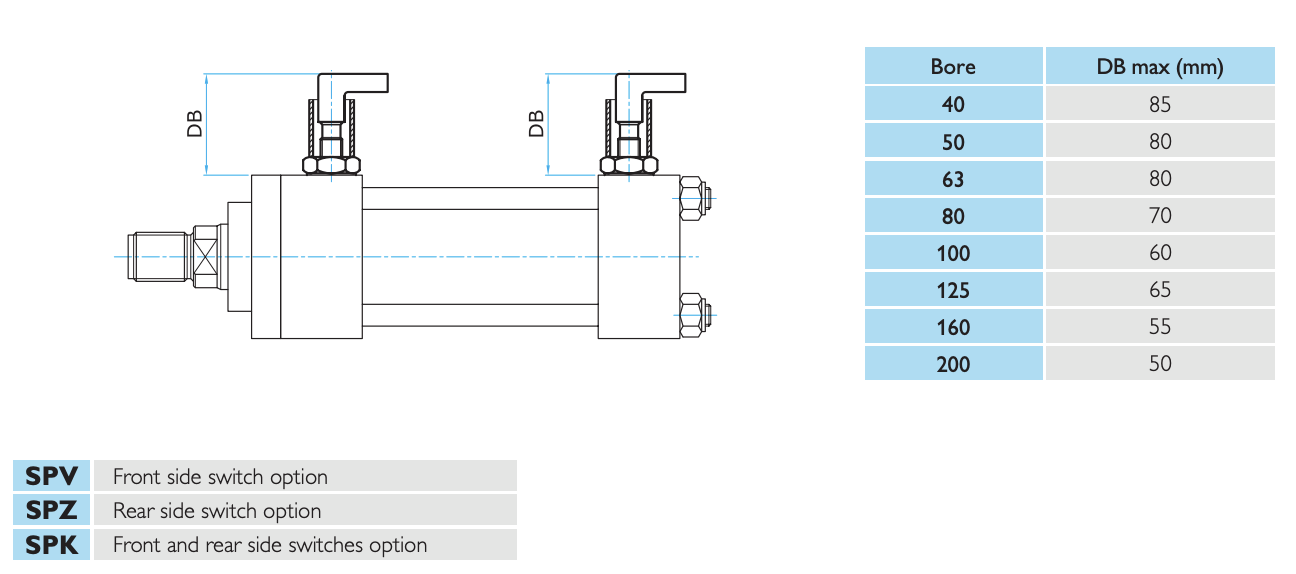
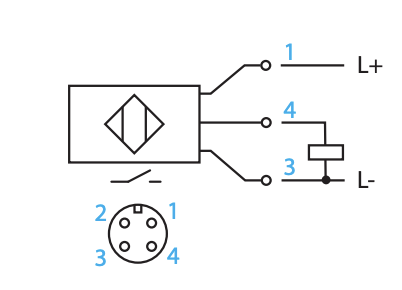
The switches are made of stainless steel, supplied correctly mounted in the cylinder and tested before dispatch. The switch is supplied with a 5 m PUR cable and an M12 connector. The output signal is controlled by a make contact ("normally open").
| Parameter | Value |
|---|---|
| Operating temperature | −25 °C / +120 °C |
| Maximum pressure | 500 bar |
| Protection | IP69k |
| Connector | S4 (M12) |
| Hysteresis | ≤ 15 % |
| Repeatability | ≤ 5 % |
| Wiring | 3 wires |
| Switching function | make contact (normally open) |
| Output signal | PNP |
| Rated operating voltage | 24 V DC |
| Rated operating current | 200 mA |
| Supply voltage | 10 / 36 V DC |
Note: for reasons of space, proximity switches cannot be used for Ø 25 and Ø 32 mm (CD series).
The choice of SPV / SPZ / SPK and its link to cushioning is handled by the configurator — for SPK it automatically requires K cushioning.
Servo cylinders — magnetostrictive sensor
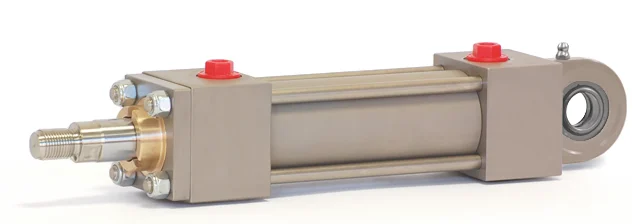
Servo cylinders TD / TK (tie-rod ISO 6020/2), TH / TX (flange-mounted ISO 6020/2) and TP (ISO 6022 heavy-duty) have an integrated magnetostrictive position sensor built into the cylinder axis. It measures the position continuously over the whole stroke, is absolute (no reference run / homing after power-up) and non-contact. This is the difference from switches and proximity sensors, which report only chosen points.
Principle: an electrical pulse travels through a ferromagnetic waveguide and, at the point of the magnet connected to the piston, a mechanical wave is created (the Wiedemann effect); the position is precisely determined from its return time. The measurement is absolute (after power-up and after a power failure the sensor knows the position immediately), non-contact (no mechanical wear, long service life even under intensive cycling) and rated IP67 for environments with dust, coolants and vibration.
- Output: analogue 4–20 mA and 0–10 V or digital SSI, CANbus, DeviceNet, PROFIBUS, PROFINET, EtherNet/IP™, EtherCAT® and POWERLINK — the same protocols as the main PLCs and control systems, so integration needs no additional adapters.
- Accuracy in practice: besides the sensor, it is also affected by the mechanics — internal leakage (seepage between chambers) and stick-slip (jerky motion at low speed). Servo cylinders therefore have tighter tolerances and high-sealing, low-friction seals for a smooth transition between static and dynamic friction.
- Sensor location: mostly externally on the rear flange of the cylinder; with some mountings (e.g. rod eye) it can be internal with a 90° output built into the cylinder body — discuss internal solutions with the technical department.
- CETOP plate (BV3 = NG6, BV5 = NG10): for the best cylinder response and the most precise positioning it is advisable to fit the servo cylinder with a CETOP plate for direct mounting of an ISO 4401 servo valve on the cylinder head — this shortens the hydraulic paths and the dead volume between the valve and the cylinder, speeding up the response and increasing the accuracy of position control.
- Applications: servo control, precise and repeatable positioning, position or force regulation, axis synchronisation.
- The sensor rod is protected by a removable steel cover on the rear head.
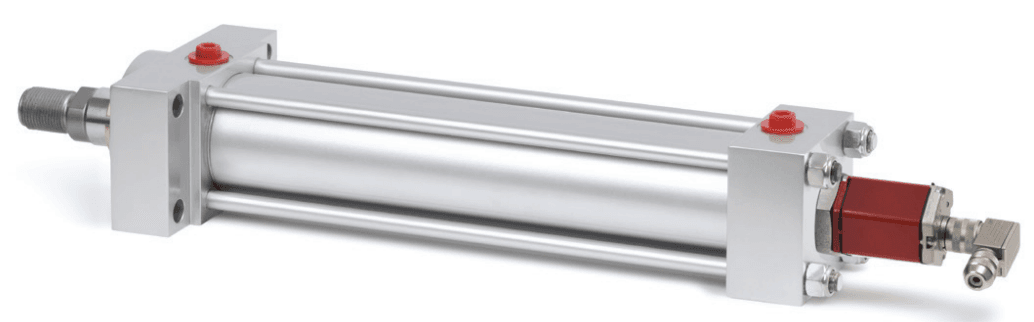
Sensor location by mounting
Depending on the cylinder mounting type, the sensor is either external (on the rear flange) or internal (integrated in the cylinder body with a 90° output):
- External sensor — mountings A, E, G, H, L, R, X.
- Internal sensor — mountings B, C, D, M, Q, S, T; on request from the technical department.
| Parameter | MV (0–10 V) | MA (4–20 mA) | MS (SSI) | MD (fieldbus) |
|---|---|---|---|---|
| Sensor type | magnetostrictive | |||
| Output | 0–10 V | 4–20 mA | SSI (serial) | CANbus, DeviceNet, PROFIBUS, EtherCAT®, EtherNet/IP™, PROFINET, POWERLINK |
| Supply voltage | 24 V DC (−15 / +20 %) | |||
| Operating temperature | −40 °C / +80 °C | −40 °C / +85 °C | −40 °C / +75 °C | |
| Max. stroke | 4000 mm | |||
| Resolution | infinite | 0.1 µm | 0.5–2 µm | |
| Linearity | < ± 0.02 % F.S. (min ± 50 µm) | < ± 0.01 % F.S. (min ± 50 µm) | ||
| Repeatability | < ± 0.001 % F.S. (min ± 2.5 µm) | |||
| Hysteresis | < 4 µm | |||
| Current draw | 100 mA (typical) | |||
| Speed | 2 m/s | |||
| Protection | IP67 | |||
Lead time 25–30 working days. The longer term is due to the delivery of the internal sensor — chiefly from the manufacturer Temposonics. The sensor can also be replaced with the customer's own make / sensor, or the cylinder can be supplied only prepared for the sensor (without the sensor) with a considerably faster lead time — you then fit your own sensor yourself. The solution is confirmed by the technical department. Details on the landing page servo cylinders with position feedback.
Benefits and where to deploy sensors
Integrating sensors turns the cylinder into an active control element — a "smart" cylinder in the spirit of Industry 4.0. Conforti therefore develops cylinders that communicate with the control system and report the piston position in real time:
- Full motion control — position (and, for servo, also speed) in real time.
- Less maintenance — continuous monitoring of the component's condition.
- Higher safety — the system can intervene automatically on a deviation.
- Easy integration — even on existing installations (retrofit, especially on MP with IO-LINK sensors).
Where it pays off the most: industrial automation (cycle optimisation, less downtime), machine tools (repeatability and accuracy at high speeds), steelworks (control even at high temperatures) and presses and lifting equipment (millimetre stroke control = both safety and performance).
Frequently asked questions
Tap a question — the answer appears below. Verified against the technical documentation of Conforti Oleodinamica.
Verified against
- Conforti catalogue — MD SERIES (magnetic switches SR/SH: voltage, IP67, clamps STA/STB/STC/STD), compact MP (SP sensor), proximity SPV/SPZ/SPK, servo TD/TK/TH/TX/TP (magnetostrictive sensor).
- Conforti Oleodinamica — sensor versions of the cylinders, servo series.
- Cylinder series catalogues and technical library: TechHub.
Temposonics® is a trademark of its respective owner; stated for identification of the internal sensor type. Lead times and the option of replacing the sensor with the customer's own make are confirmed by the hydraulika.store technical department before ordering.