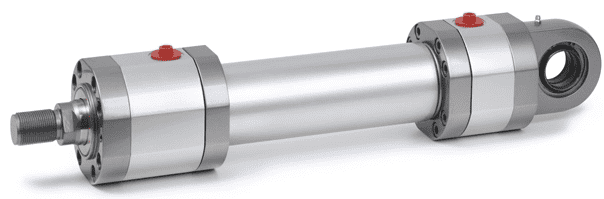
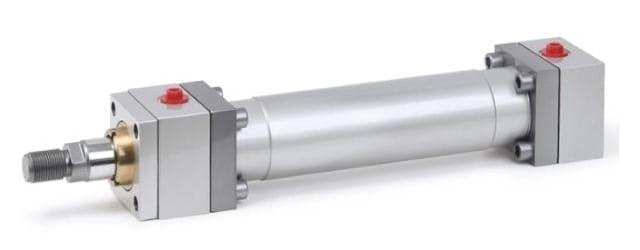
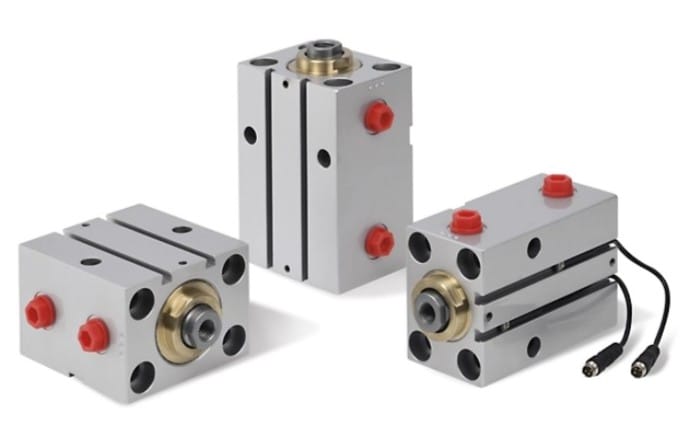
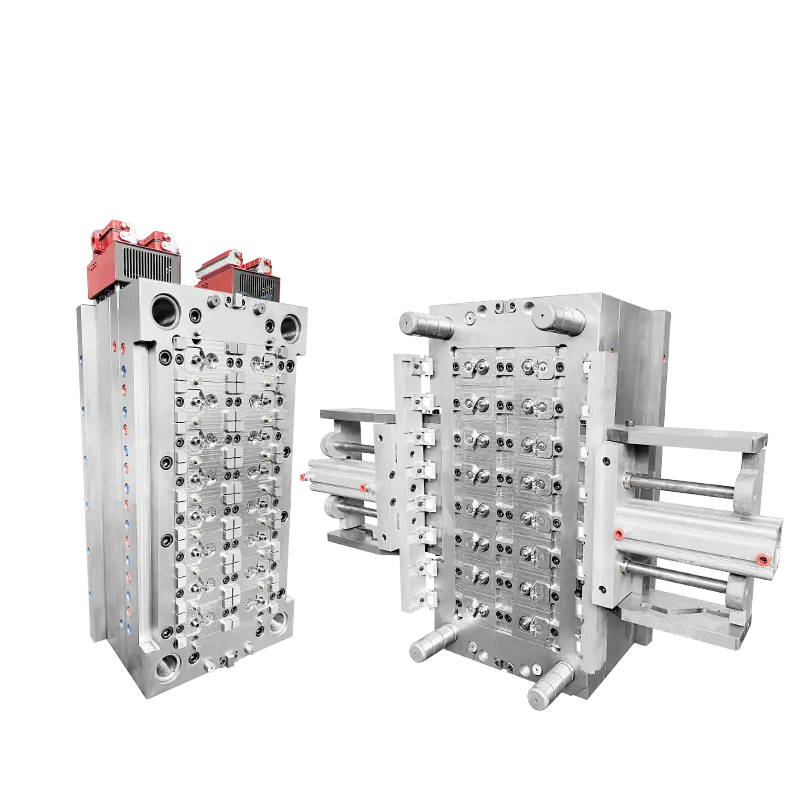
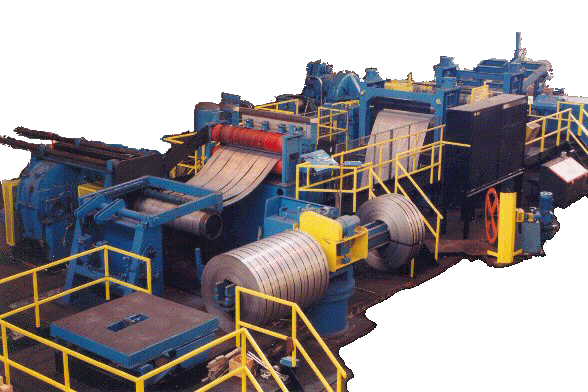
Interchangeability and standardisation
Standardised dimensions and mounting mean you can easily replace a cylinder with another branded one without modifying the machine. The end of dependence on a single supplier. Replacing Parker/Bosch/Atos →
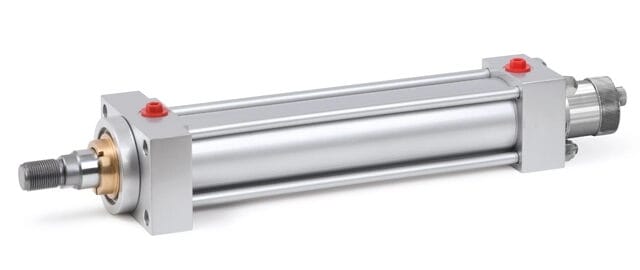 TD / TK · TH / TX · TP
For precise rod position
Magnetostrictive absolute measurement
TD / TK · TH / TX · TP
For precise rod position
Magnetostrictive absolute measurement
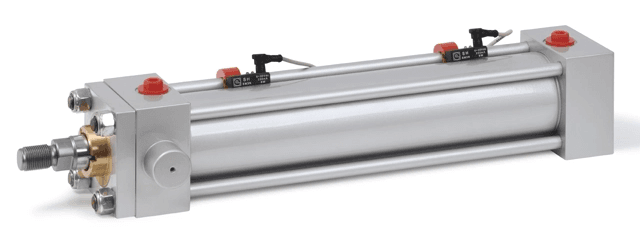 MD / MP
For intermediate and end positions
SR / SH / SP magnetic sensors · Ø 25–125 mm
MD / MP
For intermediate and end positions
SR / SH / SP magnetic sensors · Ø 25–125 mm
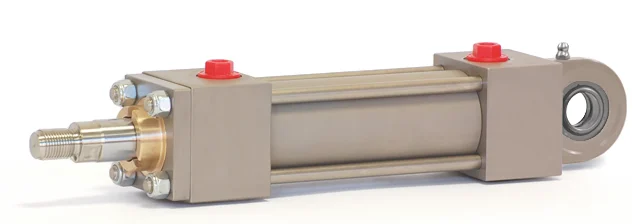 1200 h corrosion resistance
For aggressive environments
Viton® · HFC · nickel-plated surface
1200 h corrosion resistance
For aggressive environments
Viton® · HFC · nickel-plated surface
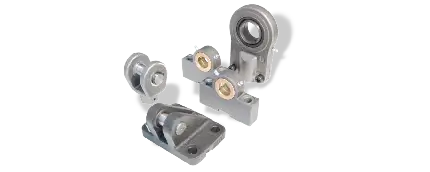 Accessories
 and spare parts
Rod eyes · mounting brackets · seal kits
Accessories
Accessories and spare parts
Rod eyes · mounting brackets · seal kits
Browse the folders just like in a file manager: series → Catalogues, Parameters, Applications, Accessories, Mounting, CAD configurator. Everything verified against the Conforti catalogue. No searching required — the tree on the left takes you exactly where you need to go.
The TechHub content was prepared and verified against the Conforti catalogue by Adam Tomášek, sales & technical representative and authorized distributor of Italian Conforti Oleodinamica hydraulic cylinders for CZ, SK and the EU since 2023. Contact →
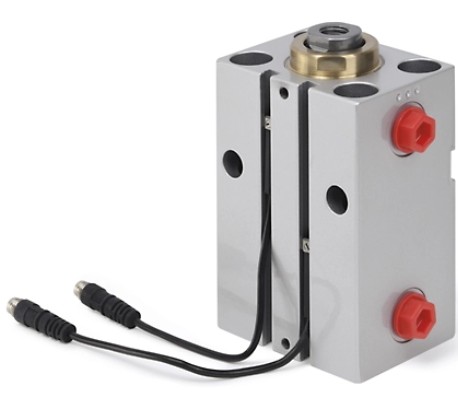
Genuine Conforti cylinders with full manufacturer's warranty. No re-exports or aftermarket. A direct distribution agreement.
A counterflange design instead of tie-rods transmits higher forces and pressures than tie-rod cylinders — for more demanding loads.
Conforti has held a certified quality management system to ISO 9001 for 18+ years. Periodically validated business processes.
The HD / HK / TH / TX series can be ordered with long strokes to suit the application — a made-to-order length to specification.
Every cylinder is subjected to an individual test protocol to ISO 10100 before delivery. Records kept on file.
Adjustable end-of-stroke cushioning and air-bleed screws for smooth and safe cylinder operation.
Manufactured in Monza (Lombardy). A proven design to ISO 6020/2 and ISO 6022, DIN 24554 / 24333.
For selected HD / HK models, express delivery within 48 hours; standard orders 10–15 working days straight from production.
Express delivery within 48 hours on selected models. Standard orders 10–15 working days thanks to direct logistics from the manufacturer.
Cylinders fully compatible with Parker Hannifin, Bosch Rexroth and others to ISO standards — without rebuilding the equipment.
As an official distributor we provide direct access to seals, guides and spare parts with a compatibility guarantee.
Technical support and preferential pricing for toolrooms, maintenance departments and OEM suppliers.
Enter the force, pressure and stroke or answer a few questions about your operation — the configurator rules out unsuitable series itself and recommends the parameters. It checks the compatibility of every choice.
Configurator by application → Code WizardThe Code Wizard walks you step by step through assembling the exact ordering SKU code to ISO standard and explains the meaning of every part of the code.
Launch Code Wizard → CAD · 3D · drawingsDownload a CAD model exactly to the SKU in STEP, IGES, DWG, PDF, Parasolid, STL and DXF formats — free and without registration.
For engineers →Conforti manufactures double-acting cylinders to ISO 6020/2 and ISO 6022, which define the dimensions and mounting so that the cylinders are mutually interchangeable across manufacturers (Parker, Bosch Rexroth, Atos).
Standardised dimensions and mounting mean you can easily replace a cylinder with another branded one without modifying the machine. The end of dependence on a single supplier. Replacing Parker/Bosch/Atos →
Conforti's modular design disassembles without special tools — replace a seal or part from a KIT set in stock. A welded cylinder is a write-off once damaged. Modular vs. welded →
Components and KIT sets (seals, sensors, mounting brackets) are in stock in every variant — solve a repair or replacement quickly and without large inventory at your site.
The two main ISO 6020/2 designs differ in how they hold the cylinder body together — this determines both the maximum pressure and the stiffness. Understanding the difference helps when selecting a series below.
The body is held by 4 tie-rods. Inexpensive and universal, 160 bar. On long strokes the tie-rods stretch elastically under load and the stiffness drops.
Counterflanges replace the tie-rods — eliminating their stretch. Higher stiffness and 210 bar at the same dimensions as CD/DK. For higher pressure and long strokes.
The most robust design, 250 bar, double bronze piston guide. For radial loads, shocks, high temperatures and contamination.
Pros and cons of each series — what each one offers and where its limits lie. Based on the Conforti catalogue and the configurator logic.
Not sure? The configurator rules out unsuitable series itself based on your input and recommends the parameters — the rules come from the Conforti catalogue.
Pick the situation that matches your operation. For each you will find a recommended series and configuration verified against the Conforti catalogue.
Why: frequent rinsing and cleaning chemicals attack the chrome on the rod and the outer surfaces — corrosion then destroys the seals and causes leaks. For corrosive environments the configurator therefore keeps the pressure to 160 bar and applies corrosion protection.
Recommended options: nickel-plating NK (1,200 h in salt spray, available for 7 of the 14 mountings — A, B, D, E, Q, R, S) and a stainless chromed rod RRX. Seal S for maximum sealing.

Why: above +80 °C standard NBR seals fail and scale with dust abrades the wiper and the rod. The heavy-duty series with bronze guides also withstands shocks and high loads in steelworks.
Recommended options: the DP series (ISO 6022, 250 bar), seal H (Viton®) up to +150 °C which also tolerates phosphate esters, a hardened rod and a metal wiper RM against scale.
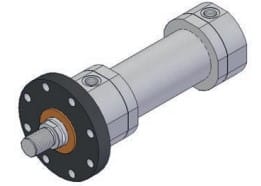
Why: side forces from misalignment push the rod against the guide bushing — on an ordinary cylinder this wears the seals and causes premature failure. DP therefore has a more robust guide.
Recommended options: the DP series with a double bronze piston guide and a long rod guide bushing — it handles radial loads that would damage a standard cylinder. For a long stroke (over 2,000 mm) combined with high speed, add the bushing drain SD. For swinging motion on ISO 6022, choose a clevis mounting (C/D/K/S) + bracket FD.

Why: in a tie-rod design the tie-rods stretch elastically under pressure — the longer the stroke, the greater the loss of stiffness. Counterflanges remove this problem and carry higher pressure in the same envelope.
Recommended options: the HD/HK series (210 bar instead of 160 at the same dimensions as CD/DK). For a long stroke (over 2,000 mm) combined with high speed, add the bushing drain SD; the configurator adds the spacer SJ itself.


Why: end-of-stroke sensors report only the extreme positions — for control across the whole stroke you need continuous feedback. A magnetostrictive transducer gives the absolute position without homing at start-up.
Recommended options: a TD/TK/TH/TX/TP servo cylinder with a transducer (MA/digital output), a CETOP plate for a valve directly on the cylinder. Note: servo cylinders use seals L/H/G, not S.
⚠ With magnetic sensors (MD: SH/SR, MP: SP) watch out for interference: ferromagnetic masses and strong fields (motors, coils, inverters) distort the signal, cables over 3 m and vibration cause false contacts. In such an environment, prefer a transducer or shield the sensor.
Why: a standard cylinder will not fit in a tight installation space. Aluminium compact cylinders are light but sensitive to shocks and pressure peaks — the steel version solves that.
Recommended options: RP/MP (aluminium, 160 bar) for light applications and clamping, RQ (steel, 250 bar) for shocks and cyclic loads. Standard strokes 20/50/80/100 mm; MP allows a REED sensor SP (3–30 V AC/DC).
Parameters of all series including a link to the detail and catalogue. For CAD and the exact SKU use the configurator.
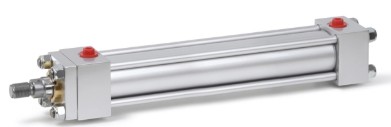
CD/DK/MD detail and catalogue →
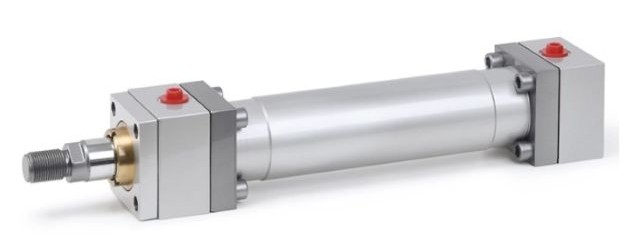

RP/MP/RQ detail and catalogue →
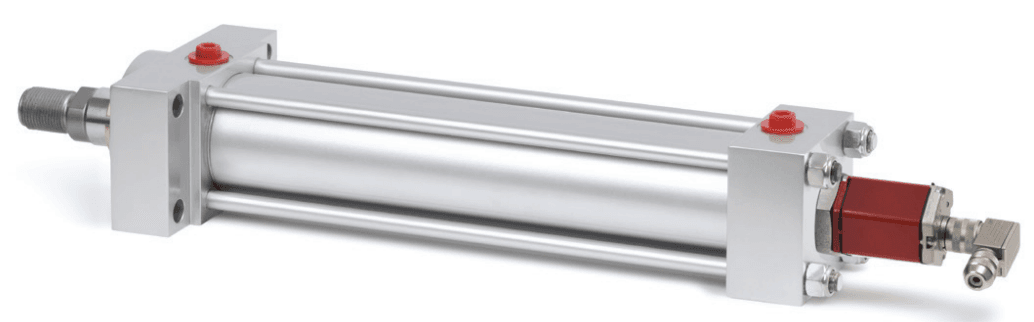
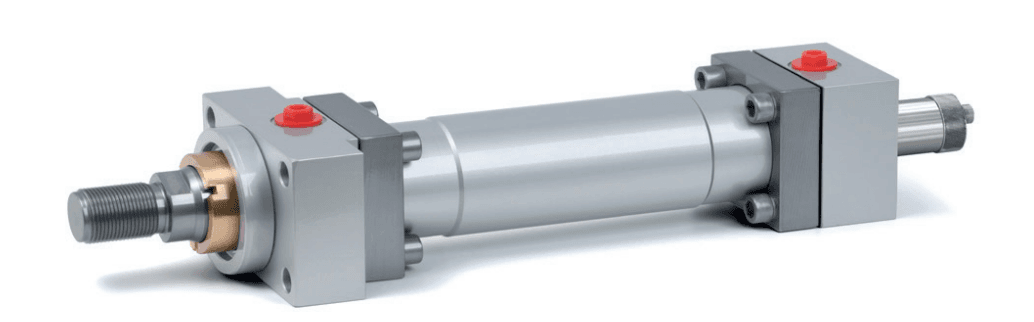
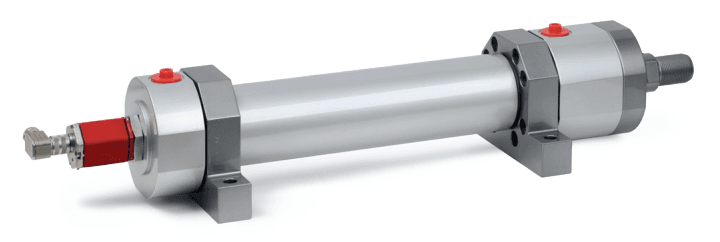
Conforti supplies mounting counterparts and rod ends as separate KIT parts. Each accessory is tied to a specific mounting type — below is an overview of when to use which. The configurator and the accessories pop-up offer the exact sizes by bore.
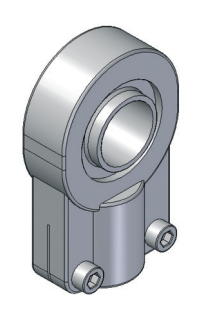 CS · ISO 6982 / 8132
An articulated spherical eye with an internal thread, screwed onto the male thread of the rod. The spherical mounting compensates for angular misalignment — suitable when the cylinder tilts as it moves. A more economical alternative to TS.
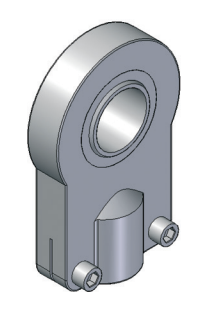 TS · ISO 8133 / DIN 24555
An articulated spherical eye with an internal thread, a different design series from CS — it has a higher load capacity for the same rod thread. It also screws onto the male thread of the rod and compensates for angular misalignment.
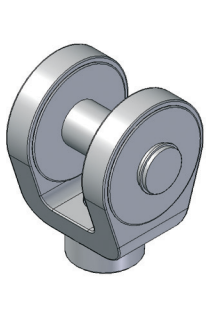 CF · clevis
A clevis end on the male thread of the rod. It connects the rod end with a pin to a counterpart in a single plane — a rigid mounting where no side tilting is expected. The configurator offers the size by bore.
LK · ISO 8132
A pair of trunnion brackets for a cylinder with mounting G (front trunnions MT1), H (intermediate trunnions MT4) or L (rear trunnions MT2) — the trunnions let the cylinder swing about its axis.
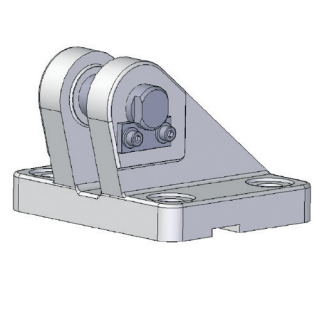 LD · ISO 8133 / DIN 24556
A counterpart for a cylinder with mounting D (MP5) on ISO 6020/2 — it allows the whole cylinder to swing. Standard combination: mounting D + LD bracket.
FD · ISO 8132
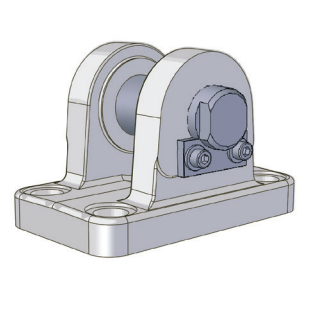
A straight bracket with a rear clevis for clevis mountings C/D/K/S on ISO 6022 (heavy-duty DP/TP). For high forces, where the cylinder is mounted via a clevis at the cap end.
Swinging cylinder motion (tilting): on ISO 6020/2 choose a trunnion mounting G/H/L + bracket LK, or mounting D (spherical eye) + angle bracket LD. On ISO 6022 (DP/TP), a clevis mounting C/D/K/S + bracket FD.
Connecting the rod end: a spherical eye CS (economical) or TS (higher capacity) — both screw onto the male thread of the rod and compensate for angular misalignment.
Size by bore: in the summary the configurator offers the exact bracket or eye size for the chosen mounting and bore — you do not have to look it up by hand.
Six model briefs show how an operational need turns into a specific configuration — and above all why each choice is made. The reasoning comes from the Conforti FAQ and the configurator rules. The exact SKU and CAD are always generated by the configurator.
Brief: a secondary motion — feeding and pressing a part clamp before an assembly operation, clamping force ≈ 50 kN, stroke 300 mm, pressure 160 bar, clean indoor operation, speed up to 0.3 m/s, end-position signalling to the PLC (24 V DC system).
V (front only), Z (rear only), K (both ends). Why K: the clamp moves in and returns at both ends, so we cushion both. It is set with a screw to suit the load and has a quick restart (per the Conforti FAQ).SV (front), SZ (rear), SK (both ends). Why SK: we bleed both chambers of the double-acting cylinder. Recommended on almost every new cylinder. (Cushioning and air bleed are two separate code fields.)MD 63 / 36 A 300 S + cushioning K, air bleed SK, sensor SH (PNP) — the code reads MD because we extended CD with a magnetic piston.Tip: the sensors only work if the stroke is greater than the catalogue minimum — the configurator checks this.Brief: force ≈ 30 kN, stroke 250 mm, pressure 160 bar, 2 end positions must be reported to the PLC, 24 V DC control system, ordinary machine environment without strong magnetic fields.
MD 50 / 28 A 250 S + 2× sensor SH (PNP), cushioning K.Tip: for continuous position measurement across the whole stroke, prefer a servo cylinder with a transducer.Brief: pushing force ≈ 120 kN, stroke 2,200 mm, available pressure 210 bar, higher stiffness requirements, indoor operation.

HD 100 / 70 A 2200 L + cushioning K, air bleed SK, SD, spacer SJ100.Tip: the bronze guide bushing reduces friction and protects the rod from scratching — keeping sealing over the whole service life.Brief: moving a hot forging with a manipulator between operations, force ≈ 120 kN, stroke 600 mm, radiant heat over 100 °C, dust and scale, arm tilting.
DP 80 / 56 D 600 H + cushioning K, RM, hardened rod.Tip: the Viton seal also tolerates phosphate esters — suitable for fire-resistant fluids in steelworks too.Brief: clamping force ≈ 40 kN, short stroke 50 mm, limited space, cyclic shock loading.
RQ 50 / 28 50 L — a compact steel clamping cylinder.Tip: if you need a position sensor on a compact cylinder, choose the aluminium MP series with the SP sensor (REED, 3–30 V AC/DC).Brief: force ≈ 80 kN, stroke 500 mm, pressure 210 bar, continuous position feedback and control required.
TH 80 / 56 MA A 500 L + CETOP plate, transducer MA.Tip: on a long stroke combined with high speed, add the bushing drain SD for smooth and stable motion.Switch on adjustable end-of-stroke cushioning. Hardened steel slows the piston before it seats and prevents mechanical shocks — it is set with a screw to suit the mass of the load and has a quick restart. Choose V (front), Z (rear) or K (both ends) by impact direction. At higher speeds, cushioning does not replace an external mechanical stop.
That is usually air trapped in the cylinder — an air-bleed valve solves it, releasing the air before commissioning. We recommend it on almost every new cylinder. Choose SV / SZ / SK. Note: cushioning and air bleed are two separate fields in the code — they can be combined independently.
On long strokes a spacer (SJ) ensures stability. You do not have to handle it by hand — the configurator adds it automatically by length. On CD/DK: 1000–1500 mm → SJ50, 1500–2000 → SJ100, 2000–3000 → SJ150, over 3000 → SJ200. On ISO 6022 (DP) the threshold without a spacer is as high as 1500 mm.
For end-position signalling choose a series with sensors. MD (magnetic piston): SH (PNP, 6–30 V DC) or SR (REED, 3–110 V AC/DC). MP (compact): SP (REED, 3–30 V AC/DC — note, NOT 24 V DC). CD/DK/HD/HK/DP have an inductive sensor in the heads (requires cushioning in the same direction). For position measurement across the whole stroke, choose a servo cylinder.
The seal determines the maximum speed, temperature range and medium compatibility. Mind the availability: seal S is not for the RQ series or servo cylinders. For dusty environments, metal wipers are also available.
Maximum sealing (NBR + PTFE). For slow, precise motion with a zero-leakage requirement.
Low friction (NBR + PTFE). A universal choice for faster and more frequent cycles.
For high temperatures and phosphate esters. Choose for hot operations and foundries.
For water emulsions and HFC fluids (NBR + PTFE CG). Choose for fire-resistant media.
A hydraulic cylinder is selected from five inputs: required force, operating pressure, stroke, speed and the environment including mounting. These yield a specific Conforti SKU, for example CD 50/28 A 500 S.
The required force determines the piston bore, the pressure defines the series: 160 bar (CD/DK/MD), 210 bar (HD/HK), 250 bar (DP/TP). Higher pressure = a smaller cylinder for the same force.
Stroke is the length of motion in mm; above 2000 mm choose counterflange (HD/HK) or ISO 6022. Speed determines the seal: S up to 0.5 m/s, L/H/G up to 1 m/s.
Temperature and media select the seal (H Viton up to +150 °C, G HFC) and treatments (NK nickel-plating). The installation determines the mounting (A front flange).
Three typical applications and specific Conforti SKUs — all bores, rods and limits verified against the Conforti catalogue.
A secondary motion on an assembly line — feeding a part clamp before an operation. A tie-rod double-acting ISO 6020/2 cylinder. Bore 50 mm, rod 28 mm cover the clamping force, mounting A (front flange ME5), stroke 500 mm, seal S up to 0.5 m/s, −20/+80 °C.
A feeder or sliding axis with higher force and a longer stroke. A counterflange ISO 6020/2 cylinder, 210 bar. Bore 80 mm, rod 56 mm, the counterflange design is more stable on long strokes, mounting A, stroke 800 mm, seal S.
Holding down a moulding on an injection moulding machine — a short pressing motion in a confined space. An aluminium compact RP cylinder (light automation, Ø40 up to 160 bar). Bore 40 mm, rod 22 mm, side ports X for a tight installation, stroke 50 mm, seal S up to 0.5 m/s.
The example CD 50/28 A 500 S is read left to right:
| Position | What it means | Example value |
|---|---|---|
| Series | Cylinder series / standard and construction | CD DK MD HD DP RP |
| Bore / rod | Piston / rod diameter in mm | 50/28 80/56 125/90 |
| Mounting | Mounting type (letter per ISO) | A front flange, B rear, E foot, D eye |
| Cushioning optional | Cushioning at the end positions | V front, Z rear, K both ends |
| Stroke | Length of rod travel in mm | 500 800 1000 |
| Spacer by stroke | Spacer for strokes from 1000 mm | SJ 50 SJ 100 SJ 150 |
| Seal | Set by speed and medium | S 0.5 m/s, L low-friction, H Viton, G HFC |
| Air bleed optional | Air-bleed valves | SV front, SZ rear, SK both ends |
| Rod end optional | Thread / eye at the end | SF internal thread, ST eye, SL DIN 24554 |
| Sensors optional | Piston position sensing | SH PNP 6–30 V DC, SR REED 3–110 V AC/DC, SP (MP) |
| PLUS options in order | Special treatments PQ → RM → NK | PQ heavy-duty piston, RM metal wiper, NK nickel-plating |
ISO 6020/2 and ISO 6022 are cross-manufacturer standards — a Conforti cylinder of the same standard and dimensions is dimensionally interchangeable (drop-in) for a Parker, Bosch Rexroth or Atos cylinder. The replacement is found parametrically, not by type number.
| Parameter | How to find it on the original cylinder | Matching Conforti series |
|---|---|---|
| Bore (Ø piston) | From the type plate / catalogue, or measure the inner diameter | Ø 25–200 mm across the portfolio — see the series ranges below |
| Rod (Ø rod) | Measure; paired with the bore in the standard | The catalogue bore/rod pairing of the given series |
| Operating pressure | Plate / documentation (bar) | ≤160 → CD/DK/MD · ≤210 → HD/HK · ≤250 → DP/TP |
| Standard | Tie-rods = ISO 6020/2 · heavy-duty = ISO 6022 | ISO 6020/2 → CD/HD · ISO 6022 → DP/TP |
| Mounting | Compare the ISO type (ME5, MS2, MP5…) | The same ISO mounting = the same mounting dimensions |
| Connection (ports) | Port size and position (G thread) | The same standard = compatible spacing and threads |
hydraulika.store does not list specific Parker / Bosch type numbers as 1:1 equivalents — we verify the replacement by parametric match. More on replacing Parker/Bosch/Atos →
Official technical catalogues from the manufacturer Conforti Oleodinamica — dimensions, parameters, mounting and coding (in English). For selection and configuration use the configurator, to order use the enquiry.
A summary catalogue of all hydraulic cylinder series — ISO 6020/2, ISO 6022 and compact.
PDF · ENTie-rod double-acting cylinders for standard industrial motion, 160 bar.
PDF · ENNickel-plated versions for aggressive and corrosive environments (1200 h in salt spray).
PDF · ENCounterflange ISO 6020/2 cylinders (210 bar) for long strokes and higher stiffness.
PDF · ENHeavy-duty 250 bar cylinders with thicker rods for high loads.
PDF · ENCompact double-acting cylinders for confined spaces — aluminium 160 bar and steel 250 bar.
PDF · ENServo cylinders with a magnetostrictive position sensor for precise positioning.
PDF · ENMounting counterparts (CS eyes, TS clevises, LK / LD / FD brackets), sealing KIT sets and spare parts with dimensions.
A complete overview of the manufactured piston-diameter (bore) and rod combinations per the Conforti catalogue. Build the exact configuration and SKU in the configurator.
| Bore (Ø piston) | Available rods (Ø) |
|---|---|
| Ø 25 mm | Ø 12 mm · Ø 18 mm |
| Ø 32 mm | Ø 14 mm · Ø 18 mm · Ø 22 mm |
| Ø 40 mm | Ø 18 mm · Ø 22 mm · Ø 28 mm |
| Ø 50 mm | Ø 22 mm · Ø 28 mm · Ø 36 mm |
| Ø 63 mm | Ø 28 mm · Ø 36 mm · Ø 45 mm |
| Ø 80 mm | Ø 36 mm · Ø 45 mm · Ø 56 mm |
| Ø 100 mm | Ø 45 mm · Ø 56 mm · Ø 70 mm |
| Ø 125 mm | Ø 56 mm · Ø 70 mm · Ø 90 mm |
| Ø 160 mm | Ø 70 mm · Ø 90 mm · Ø 110 mm |
| Ø 200 mm | Ø 90 mm · Ø 110 mm · Ø 140 mm |
| Bore (Ø piston) | Available rods (Ø) |
|---|---|
| Ø 50 mm | Ø 22 mm · Ø 28 mm · Ø 36 mm |
| Ø 63 mm | Ø 28 mm · Ø 36 mm · Ø 45 mm |
| Ø 80 mm | Ø 36 mm · Ø 45 mm · Ø 56 mm |
| Ø 100 mm | Ø 45 mm · Ø 56 mm · Ø 70 mm |
| Ø 125 mm | Ø 56 mm · Ø 70 mm · Ø 90 mm |
| Ø 160 mm | Ø 70 mm · Ø 90 mm · Ø 110 mm |
| Ø 200 mm | Ø 90 mm · Ø 110 mm · Ø 140 mm |
| Bore (Ø piston) | Available rods (Ø) |
|---|---|
| Ø 40 mm | Ø 18 mm · Ø 22 mm · Ø 28 mm |
| Ø 50 mm | Ø 22 mm · Ø 28 mm · Ø 36 mm |
| Ø 63 mm | Ø 28 mm · Ø 36 mm · Ø 45 mm |
| Ø 80 mm | Ø 36 mm · Ø 45 mm · Ø 56 mm |
| Ø 100 mm | Ø 45 mm · Ø 56 mm · Ø 70 mm |
| Ø 125 mm | Ø 56 mm · Ø 70 mm · Ø 90 mm |
| Ø 160 mm | Ø 70 mm · Ø 90 mm · Ø 110 mm |
| Ø 200 mm | Ø 90 mm · Ø 110 mm · Ø 140 mm |
| Bore (Ø piston) | Available rods (Ø) |
|---|---|
| Ø 50 mm | Ø 32 mm · Ø 36 mm |
| Ø 63 mm | Ø 40 mm · Ø 45 mm |
| Ø 80 mm | Ø 50 mm · Ø 56 mm |
| Ø 100 mm | Ø 63 mm · Ø 70 mm |
| Ø 125 mm | Ø 80 mm · Ø 90 mm |
| Ø 140 mm | Ø 90 mm · Ø 100 mm |
| Ø 160 mm | Ø 100 mm · Ø 110 mm |
| Ø 200 mm | Ø 125 mm · Ø 140 mm |
| Bore (Ø piston) | Available rods (Ø) |
|---|---|
| Ø 25 mm | Ø 18 mm |
| Ø 32 mm | Ø 22 mm |
| Ø 40 mm | Ø 22 mm |
| Ø 50 mm | Ø 28 mm |
| Ø 63 mm | Ø 28 mm |
| Ø 80 mm | Ø 36 mm |
| Ø 100 mm | Ø 45 mm |
Series-specific answers — they complement the general FAQ below. All verified against the Conforti Oleodinamica catalogue.
In which applications are ISO 6020/2 tie-rod cylinders used?
In industrial lines and machines requiring precise and powerful linear motion with high reliability — sheet-metal processing, handling and lifting equipment, automation lines, special machines.
What does it mean that the cylinders comply with ISO 6020/2?
The ISO 6020/2 standard defines the dimensions, mounting and design criteria for tie-rod hydraulic cylinders with a nominal pressure of 160 bar. It ensures interchangeability and conformity with international standards.
What is the operating pressure of tie-rod cylinders?
A nominal 160 bar, tested at 240 bar per ISO 10100. This ensures maximum strength and operating safety.
What is adjustable end-of-stroke cushioning for?
It prevents mechanical shocks and is adjustable to the specific load. Hardened steel with a quick-restart system ensures a long service life.
What are the production lead times for custom cylinders?
Our production organisation allows a custom cylinder to be prepared within extremely short lead times — up to 48 hours in urgent cases.
Which seals are available?
High sealing, low friction, high temperatures and special fluids. Metal wipers are also available for better removal of dirt from the rod in contaminated environments.
Are all cylinders tested before delivery?
Yes, all Conforti tie-rod cylinders undergo a functional test at 240 bar per ISO 10100 — ensuring reliability, safety and consistent performance.
Why do Conforti cylinders have a bronze rod guide?
Bronze reduces friction during rod motion and protects the rod surface from scratching. This maintains the sealing capability of the seals and prevents leakage.
In which applications are HD cylinders used?
In applications with long strokes (over 2000 mm) and higher pressures — handling systems, slow cylinders requiring stability, automation lines, drives for machine tools and forming machines.
Why choose ISO 6020/2 counterflanges instead of tie-rod cylinders?
Counterflange cylinders offer higher stability for long strokes by eliminating tie-rod stretch under load. They allow higher operating pressures of 210 bar (vs 160 bar on CD/DK) while keeping the same ISO 6020/2 dimensions.
What is the operating pressure of HD cylinders?
A nominal 210 bar, tested at 315 bar per ISO 10100. For extreme loads above 250 bar, consider DP (ISO 6022).
Which control systems can be connected?
Versions with end-of-stroke proximity sensors in the cylinder heads or with linear position transducers (TH/TX servo versions) are available. CETOP plates allow direct mounting of ISO 4401 valves.
Which bores are available?
HD in standard ISO 6020/2 dimensions — 50 to 100 mm. The HK variant for Ø125–200 mm.
What is adjustable cushioning for?
HD-HK cylinders can be fitted with cushioning with a quick-restart system. It prevents shocks at the ends of stroke, adjustable to the specific load.
How do I choose the most suitable cylinder?
Our configurator guides you step by step through choosing the most suitable cylinder with configuration validation. You can download 2D and 3D models with full technical documentation for immediate integration into your project.
What are the production lead times for custom HD/HK?
Up to 48 hours in urgent cases thanks to the production organisation.
Why a bronze rod guide?
Bronze reduces friction and protects the surface from scratching — maintaining the sealing capability.
Which seals are available?
High sealing, low friction, high temperatures and special fluids. Metal wipers for contaminated environments.
In which applications are DP cylinders used?
DP cylinders excel in rolling mills, forging presses and handling systems in steelworks — resistant to high temperatures, contaminants and intense mechanical stress. In presses, heavy machine tools and shearing machines they provide stability to maintain dimensional accuracy under high load.
What does it mean that the cylinders comply with ISO 6022?
The ISO 6022 standard defines the dimensions, mounting and design criteria for hydraulic cylinders with an operating pressure of 250 bar. It ensures interchangeability and conformity with international standards.
What is the operating pressure of ISO 6022 cylinders?
A nominal 250 bar, tested at 375 bar per ISO 10100. At the same piston diameter they achieve significantly higher forces than ISO 6020/2 cylinders.
When to choose a DP cylinder?
When operating pressures reach 250 bar, when significant radial loads are present, or in particularly demanding environments. The bronze guide offers higher wear resistance.
How do DP cylinders handle radial loads?
DP has a double bronze guide system on the piston plus a long bronze rod guide. This combination handles unexpected radial loads from difficult operating conditions that would endanger standard cylinders. Particularly useful in applications with misalignment or side stress.
What is the advantage of the bronze guide?
Higher service life, lower friction and better handling of radial loads compared with standard guides. Particularly useful with misalignment and side stress.
Can control systems be integrated?
Yes. We offer versions with proximity sensors, CETOP plates for control valves and servo cylinder versions (the TP series) with magnetostrictive linear position transducers.
What is adjustable cushioning for?
DP can be fitted with cushioning with a quick-restart system. It prevents mechanical shocks at the ends of stroke and is adjusted to the specific requirements and load.
What are the production lead times for DP cylinders?
Our extensive component stock enables extremely fast production — up to 48 hours in urgent cases.
Are spare parts quickly available?
Yes, spare parts are available from stock with a fast service for emergencies. Complete seal replacement sets are immediately available, enabling planned maintenance without long downtime.
Which seals are available?
High sealing, low friction, high temperatures and special fluids. Metal wipers are particularly effective for removing dirt from the rod in contaminated environments.
Are all DP cylinders tested before delivery?
Yes, all Conforti DP cylinders undergo a functional test at 375 bar per ISO 10100.
In which applications are compact cylinders used?
In many sectors of industrial automation — moulds and injection moulding machines, clamping systems, special equipment with limited space requiring high pushing and pulling forces, small handling lines.
What materials are compact cylinders made of?
From a high-strength special aluminium alloy with a wear-resistant surface treatment (RP, MP) or from steel (RQ). Light but durable — suitable for demanding operating conditions.
Are custom strokes available?
Compact cylinders are available from stock with fixed strokes of 20, 50, 80 and 100 mm. Custom strokes can be supplied on request thanks to fast production of special parts.
Can 3D CAD models be downloaded?
Yes, our configurator guides you step by step through choosing the most suitable cylinder with validation. You can download 2D and 3D models with full technical documentation for immediate integration into design projects.
When to choose RQ instead of RP?
When you need pressure up to 250 bar, shock loading or cyclic stress. RQ is the steel version resistant to pressure peaks. RP/MP (aluminium) is suitable for lighter loads up to 160 bar.
What are the pressure parameters?
RP/MP: 160 bar for Ø25–63 mm, 100 bar for Ø80–100 mm (the aluminium alloy limit). RQ: 250 bar across the whole range (steel version).
Which seal types are used?
High sealing, low friction, high temperatures, HFC compatible — for various application requirements and maximum service life.
Which accessories and configuration options?
Oil ports can be threaded or ORFS, available in several positions (front, side, rear). An additional pair of ports on request. The standard rod end has an internal thread, compatible with a male threaded rod end or a floating joint.
In which applications are TD servo cylinders used?
In applications requiring precise positioning — CNC machines, robotics, hydraulic presses with position control, automation lines with a continuous feedback signal, positioning systems.
How is the piston position detected in a servo cylinder?
Conforti servo cylinders are fitted with a high-precision linear position transducer based on magnetostrictive technology. The transducer operates contactlessly via a magnetic field — no mechanical wear, long service life. It provides an analogue output (current or voltage) or a digital signal in the SSI, CANbus, DeviceNET, Profibus, EtherCAT®, EtherNet/IP™, PROFINET or POWERLINK protocols.
What are the advantages of a servo cylinder with a transducer?
The transducer continuously provides an absolute position signal without homing after power-up and achieves extremely high resolution. A removable steel cover protects the sensitive external parts of the transducer from impacts during transport, installation and operation. Integrated CETOP plates allow direct mounting of ISO 4401 valves and servo valves on the cylinder — reducing the oil volume between the valve and the actuator and facilitating closed-loop position control.
What outputs does the transducer provide?
Analogue voltage 0-10V, current 4-20mA, or digital in the SSI, CANbus, DeviceNET, Profibus, EtherCAT, EtherNet/IP, PROFINET, POWERLINK protocols.
How do I choose the most suitable servo cylinder?
Our configurator helps with selection and technical validation. You can choose from ISO 6020/2 tie-rod servo cylinders (TD/TK), counterflange servo cylinders (TH/TX) and ISO 6022 servo cylinders (TP). The configurator performs sizing and selection from multiple options of functions, materials and accessories.
What is the operating pressure of TD cylinders?
A nominal 160 bar (same as CD/DK), tested per ISO 10100. For higher pressures of 210 bar choose TH, for 250 bar TP.
Brief terminology for selecting and configuring a hydraulic cylinder. The terms match the labelling in the configurator and in the Conforti catalogue.
Pressure acts on both sides of the piston — the cylinder extends and retracts under force. All Conforti hydraulic cylinders are double-acting.
A standard for medium-duty cylinders up to 160 bar (counterflange 210 bar) with standardised dimensions and mounting. → CD/DK/MD
A standard for heavy-duty cylinders up to 250 bar with thicker rods for high loads and buckling. → DP/TP
A standard for testing hydraulic cylinders. Every Conforti cylinder is individually pressure-tested (160 bar → test 240 bar).
A body held together by tie-rods — modular, easy to maintain and repair. CD/DK/MD series. → Standard motion
Flange mounting for long strokes and higher stiffness. HD/HK series. → Long strokes
A short envelope for confined spaces. Aluminium (RP/MP, 160 bar) and steel (RQ, 250 bar). → Compact
A cylinder with a magnetostrictive position sensor for precise positioning and closed-loop control. → Servo cylinders
Magnetic sensors (SR/SH) report reaching the end or intermediate positions to the PLC. MD/MP series. → Position sensing
A chemically nickel-plated surface 20 µm + a chromed rod = corrosion resistance of 1,200 h in salt spray. → Aggressive environments
The piston diameter (bore) determines the extend force; the annulus (bore − rod) the retract force. Marked Ø bore/rod, e.g. 80/56 mm.
The rod travel between the end positions in mm. On long strokes, watch the buckling stability of the rod.
Hydraulic slowing of the piston at the end of stroke — prevents shocks and noise. One-sided or both-sided, adjustable.
S = zero leakage, L = low friction, H = Viton® (temperatures/esters), G = for HFC fluids. Selection by medium and speed.
The way the cylinder is fixed per ISO (trunnion, flange, foot, eye). The same ISO mounting = identical dimensions = interchangeability.
An interface for mounting valves and servo valves directly on the cylinder. Shortens the oil path and speeds up the response (servo).
F = pressure × area. On extension the piston area (bore) acts, on retraction the smaller annulus area (bore − rod) — so retraction has a lower force.
Operating pressure in bar or MPa (1 MPa = 10 bar). Nominally 160 bar (ISO 6020/2), 210 bar (HD/HK) or 250 bar (ISO 6022).
Piston speed v = Q / area. Higher flow = higher speed; the configurator computes the pump flow needed for the chosen speed.
RRA aluminium bronze (light), RRB chrome-nickel (universal), RRH heavy-duty, RRX extra heavy-duty for extreme environments.
The risk of loss of stability on long strokes under compressive load. Solved by a thicker rod (ISO 6022) or a shorter free length.
An extension spacer for strokes over 1000 mm: SJ 50, SJ 100, SJ 150, SJ 200. → Long strokes
A metal rod wiper for abrasive and dusty environments. Available for CD/DK/MD/HD/HK/DP, not for the compact and servo series.
A proximity position sensor SPV / SPZ / SPK by cushioning position. An alternative to the magnetic sensors SR/SH on the MD/MP series.
Feedback position control on servo cylinders — the sensor continuously reports the position to the control system, which corrects the motion in real time.
The hydraulic oil connection — threaded or with an O-ring, in several positions (front, rear, side). Size by cylinder bore.
In the configuration code it is written right after the series if the cylinder contains any non-standard option (e.g. RM, AS).
The catalogue code of the cylinder: series, bore/rod, mounting, stroke, seal, cushioning and options — e.g. CD 80/56 A 500 S. Assembled by the configurator.
The same ISO mounting and connection = identical mounting dimensions. A cylinder can be replaced by another to the same standard without modifying the machine.
The German national designation corresponding to ISO 6020/2 — used as a synonym for medium-duty tie-rod and counterflange cylinders.
Answers verified against the Conforti catalogue.
ISO 6020/2 defines the dimensions, mounting and design rules for tie-rod cylinders with a nominal pressure of 160 bar. It ensures mutual interchangeability and conformity with international standards.
Choose DP/TP (ISO 6022) for 250 bar pressure (test 375 bar), stroke up to 6,000 mm, radial loading and demanding environments. It gives a higher force from the same bore and the bronze guides have greater wear resistance.
The DP series has a double bronze piston guide and a long rod guide bushing. This combination handles radial loads from misalignment or side stress that would damage an ordinary cylinder.
Counterflanges give higher stability on long strokes because the tie-rod stretch under load is eliminated. They also allow a higher pressure (210 vs 160 bar) while keeping the same external dimensions per ISO 6020/2 — often it is enough just to change the series without modifying the machine.
Cushioning prevents mechanical shocks at the end of stroke, is adjustable to the decelerated load and has a quick restart. The adjusting unit can also serve as an air bleed (by loosening the nut).
They are two separate SKU fields. Cushioning = V / Z / K (front/rear/both ends). Air bleed = SV / SZ / SK. They can be combined independently.
The spacer (SJ50/100/150/200) ensures stability on long strokes and is added automatically by length. On CD/DK: 1000–1500 mm → SJ50, 1500–2000 → SJ100, 2000–3000 → SJ150, over 3000 → SJ200.
Yes. MD has SH (PNP 6–30 V DC) or SR (REED 3–110 V AC/DC). MP uses SP (REED 3–30 V AC/DC, NOT 24 V DC). For continuous position measurement across the whole stroke, choose a servo cylinder with a transducer.
The TD/TK/TH/TX/TP servo cylinders have a magnetostrictive sensor that permanently measures the absolute rod position without homing at start-up. CETOP plates allow a valve to be mounted directly on the cylinder.
Yes. For corrosion (food, pharmaceutical, washing) choose nickel-plating NK (1,200 h salt spray) and a stainless rod. For abrasive dust, metal wipers and special rod materials (hardened steel, Nikrom) are available.
Metal wipers are also available to remove dirt from the rod in dusty environments.
The bronze guide bushing reduces friction during rod motion, handles radial loading better and protects the surface from scratching, thereby keeping sealing and preventing oil leakage.
A modular design disassembles without special tools — you solve a repair by replacing a seal or part from a KIT set in stock. A welded cylinder usually cannot be repaired once damaged.
We supply mounting counterparts and rod ends as KIT parts: a spherical eye CS and a clevis TS on the rod end (articulated/pinned connection), trunnion brackets LK (mounting G/H/L), an eye bracket LD (mounting D) and a heavy-duty bracket FD (DP/TP clevis mountings). Each is tied to a mounting type — in the summary the configurator offers the matching size by bore.
Yes, per ISO 10100 (ISO 6020/2 at 240 bar, ISO 6022 at 375 bar). In urgent cases an atypical cylinder can be delivered within 48 hours.
A cylinder is chosen from five inputs: required force (determines the piston bore), operating pressure (defines the series — 160, 210 or 250 bar), stroke, speed (determines the seal) and the environment including the mounting. These parameters yield a specific Conforti SKU, for example CD 50/28 A 500 S.
If the original cylinder is to ISO 6020/2 or ISO 6022, a Conforti cylinder of the same standard and the same dimensions is dimensionally interchangeable (drop-in). The replacement is found parametrically — by reading off the bore, rod, pressure, standard, mounting and connection from the original cylinder, not by the Parker or Bosch Rexroth type number.
CD is a tie-rod double-acting cylinder to ISO 6020/2, 50/28 is a piston diameter of 50 mm and a rod of 28 mm, A is the front flange mounting (ISO ME5), 500 is the stroke in mm and S is the standard high-sealing set (NBR + PTFE) up to a speed of 0.5 m/s and a temperature of −20 / +80 °C.
The CD, DK and MD series are tie-rod cylinders to ISO 6020/2 with an operating pressure of 160 bar. CD covers bores Ø 25–100 mm, DK Ø 125–200 mm and MD Ø 25–125 mm (with a magnetic position sensor). For 210 bar there are the counterflange HD/HK, for 250 bar the heavy-duty DP/TP to ISO 6022.
The order is: series / bore-rod / mounting / (cushioning) / stroke / (spacer) / seal / (air bleed) / (rod end) / (sensors) / options. Special options are written in the order PQ → RM → NK. The mandatory positions are series, dimensions, mounting, stroke and seal.
For piston speeds above 0.1 m/s it is advisable to limit the stroke on the compact series with an external mechanical stop, so that the piston does not hit the guide bushing. It is not an exclusion rule but a safety recommendation — the configurator flags it.
SD is a drain port in the cylinder head that carries off excess oil from the space between the wiper and the primary seal. The configurator recommends it for the combination of a long stroke (over 2000 mm) and high speed. It is not available for the compact RP/MP/RQ series (a different guide design).
RP is made of an aluminium alloy (light, cheaper), RQ of steel. Choose RQ where pressure shocks, impacts or cyclic stress occur that shorten the life of the aluminium RP. RQ also withstands the full 250 bar (RP/MP only 160 bar for Ø < 80 mm, or 100 bar for Ø ≥ 80 mm).
The mounting determines the stroke factor FC for calculating rod buckling. FC = 0.7 (front flange with a freely guided end) is the best for long strokes; FC = 4 (rear threads as a cantilever) is the least favourable. LI = stroke × FC applies, where LI is the equivalent buckling length for the Euler calculation. The configurator verifies this automatically.
Extend force: F [kN] = P [bar] × A [cm²] ÷ 100, where the piston area A = π × Ø² ÷ 4. Example for Ø 80 mm at 160 bar: A = 50.27 cm², theoretical F ≈ 80 kN. The retract force is lower (calculated from the annulus area). The operating force is about 7% lower due to seal friction (η ≈ 0.93) — the configurator shows operating values with efficiency included.
The ISO 6020/2 series (CD, DK, MD, HD, HK, TD, TK, TH, TX) and the TP servo cylinder have a maximum of 4000 mm; heavy-duty DP (ISO 6022) up to 6000 mm; compact RP/MP/RQ standard 20/50/80/100 mm (others on request). On long strokes the configurator recommends an SJ spacer, and over 2000 mm at high speed also the SD drain.