Modular vs. welded hydraulic cylinders — comparison of construction, servicing and cost
A modular hydraulic cylinder (tie-rod or bolted/counter-flange construction per ISO 6020/2 or ISO 6022) is fully serviceable: the heads, piston, guide bushing and seals can be replaced with ordinary tools, and thanks to the ISO dimensions we supply seal sets and individual cylinder components as spare parts for maintenance and servicing. A welded cylinder has its head(s) joined to the tube by a weld — it is more compact and cheaper in volume production, but repair is limited and the dimensions are proprietary. For industrial machines, where the cost of downtime is decisive, the total cost of the modular design usually comes out lower. hydraulika.store — authorised distributor of Conforti Oleodinamica (CZ/SK, delivery across the EU) — supplies ISO modular cylinders as standard within 14 days, urgently from 48 h.

Article contents
Two construction philosophies
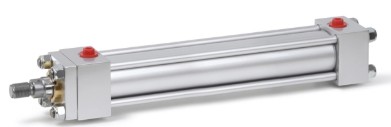
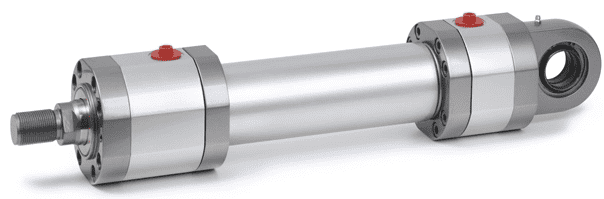
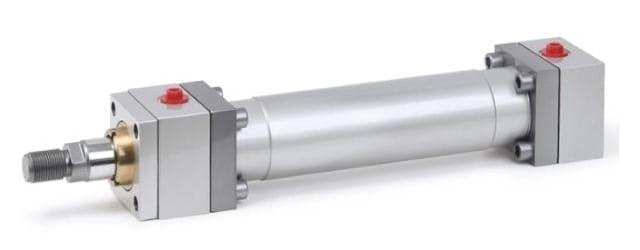
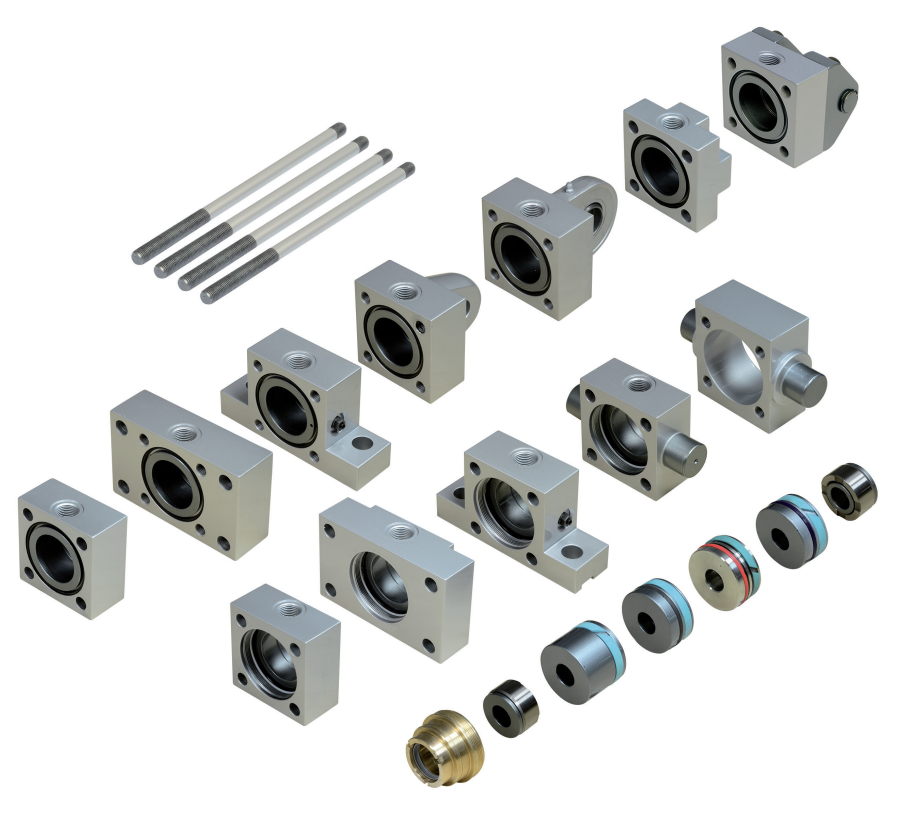
A modular cylinder is held together mechanically: by four tie-rods (typically ISO 6020/2), or by bolts and counter-flanges or threaded joints in heavy-duty and round designs. Every functional part — front and rear head, guide bushing, piston, cushioning rings, seals — is a separate, replaceable component.
A welded cylinder has the tube and at least one head joined by a weld into a single unit. This creates a compact, smooth body with no external tie-rods — typical of mobile hydraulics (loaders, cranes, agricultural machinery), where envelope, weight and cost at high volumes matter.
So the question is not "which is better" but what the component will cost over the whole life of the machine — and how quickly you can get it back into operation when it fails.
Mounting: modular has a choice, welded is usually only eye–eye
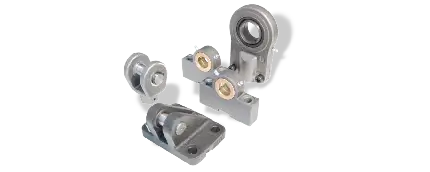
The biggest practical difference is in the way it is mounted to the machine. A modular ISO cylinder offers 14 standardised variants — front and rear flange, feet, front and intermediate trunnions, spherical eye — so it can be implemented onto the machine structure in several different ways. Welded cylinders, by contrast, are made as standard only in the eye–eye (clevis–clevis) configuration; other mounting geometries are not normally offered.

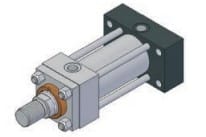
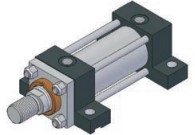


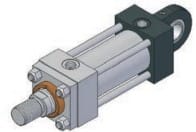
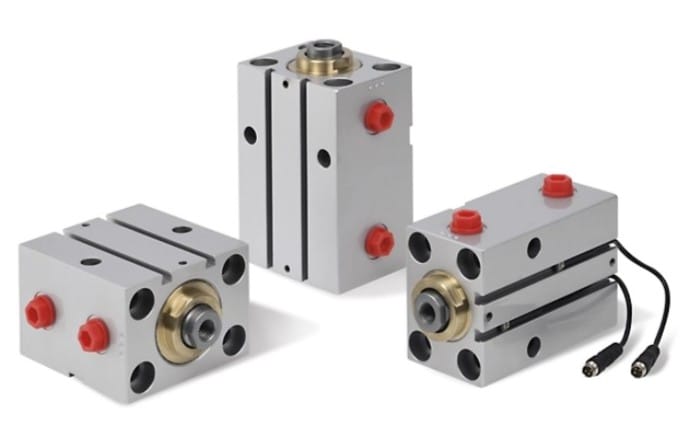
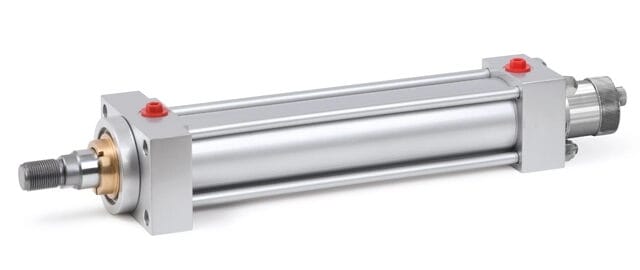
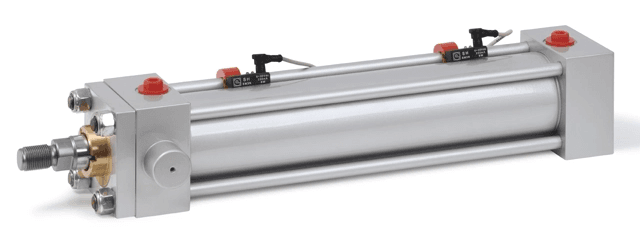
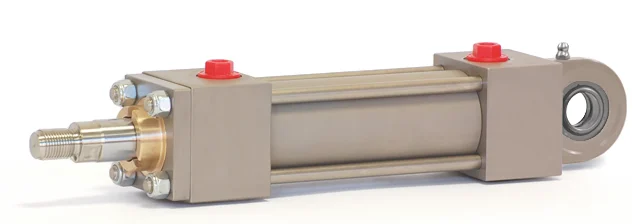
Six of the 14 mounting variants per ISO 6020/2 (actual Conforti mountings) — a welded cylinder does not offer this choice as standard.
Parameter-by-parameter comparison
| Criterion | Modular (ISO) | Welded |
|---|---|---|
| Serviceability | full — tie-rods allow quick disassembly and maintenance | limited — access to the piston often only through a threaded head, sometimes not at all |
| Seal replacement | ordinary tools; we supply seal sets as spare parts | often special tooling; seals tied to the manufacturer |
| Mounting | 14 variants per ISO — flanges, feet, trunnions, spherical eye | usually only eye–eye (clevis) |
| Configurability | piston rod material, seals, cushioning, sensors — all within ISO | fixed design, options limited |
| Interchangeability | envelope dimensions per ISO 6020/2 / ISO 6022 → 1:1 replacement from another manufacturer | proprietary dimensions → replacement only with the original or a bespoke build |
| Spare parts | heads, bushings, pistons, KIT components in stock | usually the whole cylinder |
| Envelope and weight | larger external envelope (tie-rods, flanges) | compact, smooth body |
| Purchase price | higher per unit in small batches | lower at OEM volumes |
| Typical application | industrial machines, presses, automation, machine tools | mobile equipment, volume OEM applications |
| Downtime on failure | part replaced within hours (part in stock) | waiting for the original / manufacturing a new cylinder |
Configurability: what you can specify on an ISO cylinder
A "standard" ISO cylinder does not mean a "rigid" one. Within the standard you can freely combine a range of options without giving up the benefits of standardisation (stocked spare parts, interchangeability, short lead times). That is precisely where the main benefit of the modular design lies:
- Piston rod material — chrome-plated CK45 (standard), chrome-plated stainless (RRX), heat-treated, Nikrom or induction-hardened chrome-plated steel.
- Seals — high-sealing (standard), low-friction (for precise and smooth movement), Viton® for high temperatures, or for water-glycol.
- Cushioning and wipers — adjustable end-of-stroke cushioning, a metal scraper (RM) for dusty and abrasive environments, bushing drainage (SD) for long strokes and fast cycles.
- Mounting — any of the 14 variants per the standard (see above).
- Sensors — extension with magnetic sensors (MD series) or a magnetostrictive transducer (TD / TK / TH / TX) with no design compromises.
- Easy maintenance — thanks to serviceability and the "stacking" of functional parts, you can replace wear parts (seals, bushings) even in continuous operation, without manufacturing a whole cylinder.
In practice, what a customer calls a "bespoke cylinder" is therefore very often an ISO cylinder with the right options selected — and, compared with a special, it has one extra advantage: seals, bushings and pistons are in stock.
When a configurable ISO cylinder is enough
- Aggressive / corrosive environments — often a chrome-plated stainless rod (RRX) + 20 µm electroless nickel plating of the body (1200 h in salt spray, rating 10) is enough instead of more expensive all-stainless.
- Dust and abrasives — a metal scraper (RM) wipes away even the fine particles that an elastomer wiper lets through.
- Long strokes / fast cycles — bushing drainage (SD) and, for strokes over 2000 mm, a flange design (HD / HK) that eliminates tie-rod stretching.
- Position sensing — magnetic sensors (MD) or a transducer (TD / TK / TH / TX), natively and without altering the design.
- Radial loads — heavy-duty DP per ISO 6022 with double bronze piston guidance and a long bronze bushing.
The time factor: a configurable ISO cylinder with pre-defined options is manufactured very quickly (in urgent cases from 48 hours), because the components are in stock. For critical machines it is worth planning a spare cylinder in advance. You can find the configuration, a 2D/3D model and the lead time in the configurator.
Servicing: where the modular design pays off
A sudden cylinder failure stops the whole line and downtime costs grow exponentially — an hour of standstill means thousands to tens of thousands of euros in demanding operations. The difference between a crisis and routine is the speed of recovery:
- With a modular cylinder you replace the bushing, seal or piston on site; KIT components are fitted without special tools and delivered very quickly.
- The ISO 6020/2 tie-rod design makes disassembly and preventive maintenance easier — which is exactly why the standard and manufacturers recommend it where maintenance is expected.
- When repair is uneconomical, the ISO dimensions allow the cylinder to be replaced with one from another manufacturer without modifying the machine — for example as a replacement for Parker or Bosch Rexroth, and vice versa: the machinery fleet stops being a hostage to a single brand.
A welded cylinder is harder to repair: you often cannot reach the piston without cutting or unscrewing the pressed-in head, and after cutting into the weldment the liability rests with whoever did it. In mobile equipment, where the cylinder is a cheap volume part, this does not matter — the whole thing is replaced. In industry, with an atypical unit, it means waiting for a new one to be manufactured.
Where it is decided: a modular cylinder returns the machine to operation within hours (part in stock), a welded one within days (manufacture or original). In industry, total cost is decided by the speed of recovery, not the purchase price.
Quality and predictability: what the standard adds
Conforti modular cylinders are manufactured per ISO 6020/2 (CD/DK 160 bar, heavy-duty HD/HK 210 bar) and ISO 6022 (DP, 250 bar). Every unit undergoes a 100% pressure test per ISO 10100 at 1.5 times the working pressure (240 / 315 / 375 bar) with the results recorded — traceable even years later. The stroke holds the ISO 8131 tolerance (0/+2 mm). The ground chrome-plated CK45 piston rod and bronze guide bushings protect the seals and extend service intervals.
This does not mean a welded cylinder cannot be of high quality — it means that with an ISO design the quality is measurable against the standard and serviceability is a feature of the design, not the manufacturer's goodwill.
Quick guide: an industrial machine with expensive downtime → a modular ISO cylinder. Mobile equipment and large volumes with the part in stock → a welded one makes economic sense.
Total cost of ownership (TCO)
A cheaply bought cylinder can quickly turn into a loss when it fails in the middle of a production cycle: stopped production, penalties for late deliveries, overtime to catch up on the plan. TCO therefore includes:
- purchase price,
- the cost and availability of spare parts (seals, bushings, pistons),
- servicing effort (tools, time, skills),
- cost of downtime × the probability of waiting for a part,
- residual flexibility (can the cylinder be replaced by another supplier?).
In items 2–5 the modular ISO design systematically wins. The welded cylinder wins on item 1 — and wherever items 2–5 are small (a cheap volume part in stock at an OEM).
When to choose which — a quick guide
- Industrial machine, press, automation, long service life, expensive downtime → a modular ISO cylinder (CD/DK/MD, HD/HK, DP).
- Mobile machine, large volumes, minimal envelope, part usually in stock → a welded cylinder makes economic sense.
- Not sure? The configurator guides the selection by application; technical consultation on +420 702 171 872.
How to choose the right modular cylinder step by step is covered in the article How to choose a double-acting hydraulic cylinder.
Frequently asked questions
Tap a question — the answer appears below. Verified against Conforti documentation and ISO standards.
Verified against
- Conforti Oleodinamica — PLUS: ISO interchangeability, ISO 10100 testing, downtime costs, custom cylinders.
- Conforti catalogues (Catalogo_EN, DP_EN, HD_HK_EN, Catalogo_KIT_EN) — standards, pressures, materials, ISO seal grooves, KIT.
- Cylinder series catalogues and technical library: TechHub.
The characteristics of welded cylinders are given in general terms, without specific figures and without reference to any particular manufacturer. The TCO chart is illustrative and contains no specific amounts.